Field Visualizer

INTRODUCTION
Field Visualizer by MidWest Gadgets.
I love my field detector; it is a fantastic tool to accompany a repeater sticker and is perfect for finding that initial sticker placement.
The DT Diagnostic Card is perfect to see if a 13,56MHz field exists and to identify the duty cycle, but as it says on the tin, the Field Visualizer is the tool for actually visualizing the field. After all, what’s better than 1 field detector? How about 6, 9, or even 14?
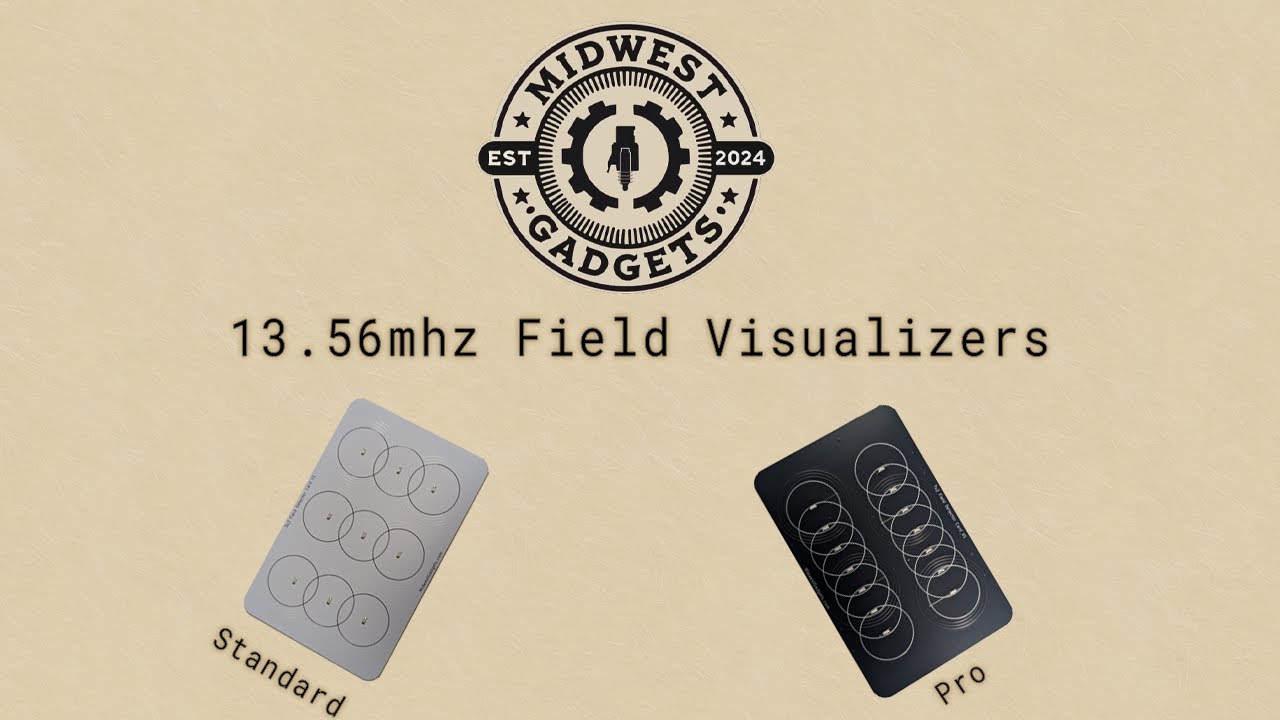
These units exist to answer the need for a physical representation of where a 13.56 MHz High Frequency (HF) NFC field actually lives. It’s the next step up from a single LED diagnostic tool, adding a full array of indicators. This is the hardware that finally allows us to stop guessing and start seeing the real shape of the field on those tricky access control systems and pocket readers aka Phones.
The Field Detectors are $25 cheaper than the Field Visualizer Card. Imagine taking one of those little guys and multiplying it by 6 (Ring), 9 (Standard), or 14 (Pro). While the single detectors are great for your Hammy Sticker placement, if you want to see the whole field shape at once without moving a tiny chip around, I would highly recommend the Card version as the better option.
The card is significantly larger than a field detector but it also provides a much wider area of detection.
So far, I haven’t found an HF reader I can’t… visualize
example
TESTING INCLUDING READ RANGES
Not particularly relevant for this testing, you’ll want to move the Field Visualizer around to find the “sweet spot” or the exact edge where the field drops off. As you move it through the field, the LEDs light up sequentially, signifying exactly where the energy starts and ends.
SPECIFICATIONS
All standard ISO Credit Card card size (except the ring at ~60mm ∅)
Standard Model:
3x3 array of LED’s in a 4 layer PCB (9 detectors total)
Pro Model:
7x2 array of LED’s in an 8 layer PCB (14 detectors total)
Field Visualizer Ring:
6 LEDs in a circular array (6 detectors total)
Antennas:
Integrated within the PCB layers
Frequency:
13.56MHz (HF)
Battery:
None (Passive - powered by the field)
PROs
• Works on all 13.56MHz readers (tested so far) including phones, Flipper, ACR122U, Door Readers and an EFTPOS terminal
• Visualise fields in real-time
• No batteries required; no setup or installation needed
• Easy to use
• Easy to read
• Perfect for finding antenna placement
• Fits in a wallet
- Depending on the reader power, the LEDs on the outer edges might be dimmer than the center which helps with the visualisation
CONs
- There really aren’t any cons to this
“HACKS”
Can be used to map the exact antenna geometry of a phone or reader by sliding it across the surface. There is also a 3D-printable case available for the 7x2 model (and soon the 3x3) which is free to download and print yourself.
The Sizes
Standard - Great for general purpose and most DIY projects.
Pro - The high-density 7x2 array allows the LEDs to be spaced closer together, giving a much higher resolution “image” of the field shape.
Ring - If you prefer a different form factor option, the Field Visualizer Ring packs 6 LEDs allowing you to see the field doughnut 
ALSO
Because these are passive, you can leave them near a high-powered reader indefinitely to act as a visual status indicator
PRICE
USD $30.00ea for the Ring (6 LED) Standard (9 LED) and Pro (14 LED)
SUMMARY:
I must admit, when I first saw these, I could see the practicality, and I thought they looked cool, but I wasn’t sure if I would use it. But they are really great, for all the obvious reasons
The Field Visualizer turns the art of “guessing where to put your implant” or “figuring out why this lock sucks” into a visual, repeatable science. The addition of the LED array addresses the single biggest weakness of single-point testers when dealing with real-world access control hardware. This is required gear for the 13.56MHz power user.
LINKS AND RESOURCES
https://www.midwestgadgets.org/product-page/13-56mhz-field-visualizer
POLL
Rating by the community 
PLEASE ONLY VOTE IF YOU HAVE ONE OR HAVE USED ONE
 =
= 
= 
= 
= 
= 
- 1
- 2
- 3
- 4
- 5