Cardinal Compass Wearable

Community Project: Cardinal
Anyone who would like to contribute feel free to add your thoughts here. If you need to make purchases to support your contribution to the project, see this thread , and direct message @amal or @Satur9 with details. Project threads can get a little out of hand with tons of people brainstorming. I ask that you limit your messages to the topic at hand. Try to condense multiple messages into one post.


First off, this project has been created by 24HourEngineer (McSTUFF). They are loosely affiliated with Grindhouse Wetware, and they originally approached me for help with this project a year ago. They have posted all the content in the public domain, so I’m not hesitant sharing. Credit where credit is due though. McSTUFF, if you’re around you can feel free to weigh in with insights and direct our efforts.

The idea with this project is to create a small wearable device (25mm x 5mm disc) that will vibrate when the user is facing north. Wearing the device as a pendant or on a belt will ensure it remains facing forward. This idea is similar to a very old project called the Northpaw, and also Lepht Anonym’s attempts at creating an implantable version called the Southpaw.
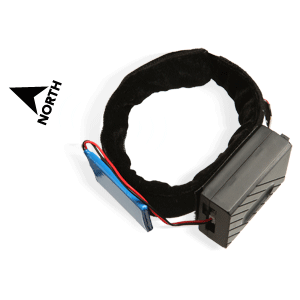
Lepht and McSTUFF would like to transition the build to an implantable version (and they can achieve it with Grindhouse Wetware and Cassox’s PMMA encapsulation experience). The only way I see that working is with rechargeable batteries, though. Even LIR2032 batteries will offgas and may compromise any encapsulation, so I’m not comfortable making that into a ā€œproductā€. Any effort we put into making a tiny wearable device will be in the public domain, though. So if some enterprising biohackers want to create an implantable version themselves, more power to them.

McSTUFF has already shared a GitHub repo with the code and a section of their blog detailing the build journey.

I made an earlier prototype before linking up with McSTUFF, which was made from a BBC micro:bit v1 with a lithium-ion battery. It was compact and easy to set up, with a compass module on-board. Unfortunately the accuracy was pretty terrible and all the users abandoned it.

The current iteration of the Cardinal uses a BNO055 IMU to achieve much more accuracy. It was being paired with a 32u4 MCU. The MCU would trigger some BJT transistors that would drive some vibrating disc motors. McSTUFF also had some ambitions to incorporate bluetooth, although I don’t know the details of that.

Next Steps:

  • Prototype with some development boards until we have reliable enough performance
  • Test low power motor drive (capacitor bank with LIR2032?)
  • Begin designing custom PCB

Current collaborators: @Satur9

4 Likes

I really like the idea of this project and I want this in a belt buckle! I’ve acquired an ATMega32u4 in the form of a Teensy 2.0 and a BNO055 breakout board from Adafruit. I worked up bare-bones bit of firmware that initialized the BNO055 in compass mode and reads the X value from the euler registers. It outputs that on a NeoPixel ring so that, in theory, the light will point North.

I haven’t done anything with calibration yet, but it doesn’t seem to bad. Here’s the repo for the code: Bitbucket

Next steps are:

  • Add calibration
  • Figure out how to make it work standing up as well as laying down
  • Switch from the NeoPixel to the little vibration motor I have.
  • Design a custom PCB and belt buckle housing
4 Likes

If you want/need help with that feel free to reach out

1 Like

I absolutely will. I’ve never designed a PCB before and it’s pretty intimidating.

1 Like

I saw the Belt Buckle concept and it’s great for navigation. However, I’m researching sensory substitution specifically for Aphantasia (I have no visual imagination).

My hypothesis is that for the brain to integrate magnetic north as a ā€˜native sense’ (and not just a buzzing notification), the transducer needs to be on a high-sensitivity area closer to the vestibular system.

I’m prototyping a ā€˜Nexus-Pendant’ designed to sit over the C7 vertebra or the Solar Plexus. The goal: To use ultrasonic pressure or TENS (electrical stimulation) instead of motors, creating a ā€˜phantom pressure’ sensation that aligns with the body’s axis.

Has anyone experimented with haptics on the neck/spine versus the waist? I’m curious about the long-term neuroplasticity effects in these different zones.

—–

I’m working on a sensory substitution project (Project EIDOLON) aimed at treating Aphantasia through haptic feedback on the C7 vertebrae/Sternum. Phase 1 is currently external (using transducers), but I’m hitting a hard psychophysical limit: Mechanical Latency.

Even with tuned LRAs or voice coils, the ā€œramp-upā€ time and the travel time of the mechanical wave through tissue creates a lag. The brain interprets this as a ā€œnotificationā€ (someone poking me) rather than a direct ā€œsenseā€ (an immediate change in the environment).

The Proposed Phase 2 (Implantable): I am investigating the feasibility of a Passive Subcutaneous Neuro-Stimulator. Imagine a custom x-series form factor (glass capsule), but instead of driving an LED (like the xLED), the LC coil drives two exposed electrodes at the tips of the capsule.

  • The Goal: To rectify/demodulate the external magnetic field (from my wearable) into a controlled electrical stimulus directly into subcutaneous nerve endings.

  • The Advantage: Zero mechanical latency. Pure data-to-nerve signal transduction.

  • The ā€œFeelā€: A controllable tingle/sparkle (paresthesia) instead of a vibration.

My Engineering Concerns (Where I need your wisdom):

  1. The Glass-to-Metal Seal (Feedthrough): I know getting a hermetic seal with Platinum/Iridium wire exiting borosilicate glass is the holy grail/nightmare of medical manufacturing. Has anyone in the DT community successfully prototyped a feedthrough that survives long-term without leakage?

Electrolysis & Charge Density: Since x-series implants have tiny surface areas, standard Pt electrodes might hit the ā€œwater windowā€ limit too fast, causing tissue damage. I’ve been reading about AIROF (Activated Iridium Oxide Film) to increase Charge Injection Capacity (CIC). Is this overkill for a simple ā€œticklerā€, or a hard requirement to avoid necrosis?

  1. The Circuit: I assume I can’t just dump raw HF (13.56 MHz) into the tissue. I’d need a micro-Schottky diode + cap to create an envelope detector (AM demodulation) to turn the carrier wave into a perceivable 50Hz-100Hz pulse train. Has anyone fit a demodulator circuit inside a 3mm glass tube?

I know this is pushing the boundary from ā€œstorageā€ to ā€œstimulationā€, but for sensory augmentation, eliminating mechanical lag seems to be the only way to achieve true integration.

Any thoughts, warnings, or ā€œdon’t do this you’ll dieā€ advice would be greatly appreciated.

2 Likes

I would avoid direct neck / spine stimulation since the spinal cord is what I would consider to be a no-go zone.

This is surprising. Can you explain ā€œlagā€.. lag versus what? How is the brain determining this slight time delay to be ā€œlagā€ - i.e. what is it comparing the signal reception to?

I’m also surprised because the brain is quite good at reconciling lag - it must do this for signals coming from far away places like your feet vs your face. There is also the tendency toward time normalization via sensorimotor temporal recalibration.

We’ve not bothered, however I am interested in implants that are able to interact with surrounding tissues and devised a nano-doping method that involves treating biocompatible materials with gold nano-particles which could achieve enough density to carry a differential field.. not suitable for power transfers but enough potential for extremely low voltage / low current applications like SENS (Subdermal Electrical Nerve Stimulation). I’ve not had reason to practically apply this concept to product manufacture yet.

1 Like

This experiment on brain timing was quite interesting.

https://www.sciencedirect.com/science/article/pii/S0896627306006271

https://www.pbs.org/video/brain-david-eagleman-why-time-seems-slow-when-we-are-extremes/

@amal Thanks for the insights on Eagleman and temporal recalibration. You are absolutely right that the brain buffers and syncs inputs.

I suspect the ā€œnotificationā€ feel vs ā€œsenseā€ feel might also be related to the ADSR Envelope of the actuator. Standard motors have a mechanical ramp-up (slow attack), whereas real tactile events usually have sharp transients. That’s why I’m moving away from ERMs.

I’m currently deep in the exploratory phase, testing different approaches to bypass skin saturation and latency—ranging from bone conduction on C7 to experimental ideas like ultrasonic heterodyning to create phantom sensations deep in the tissue.

The Gold Nano-doping concept for SENS sounds incredible for active implants. I’ll definitely keep an eye on that.

I’ll be documenting and posting my results here as I advance with the prototypes. Thanks for the guidance!