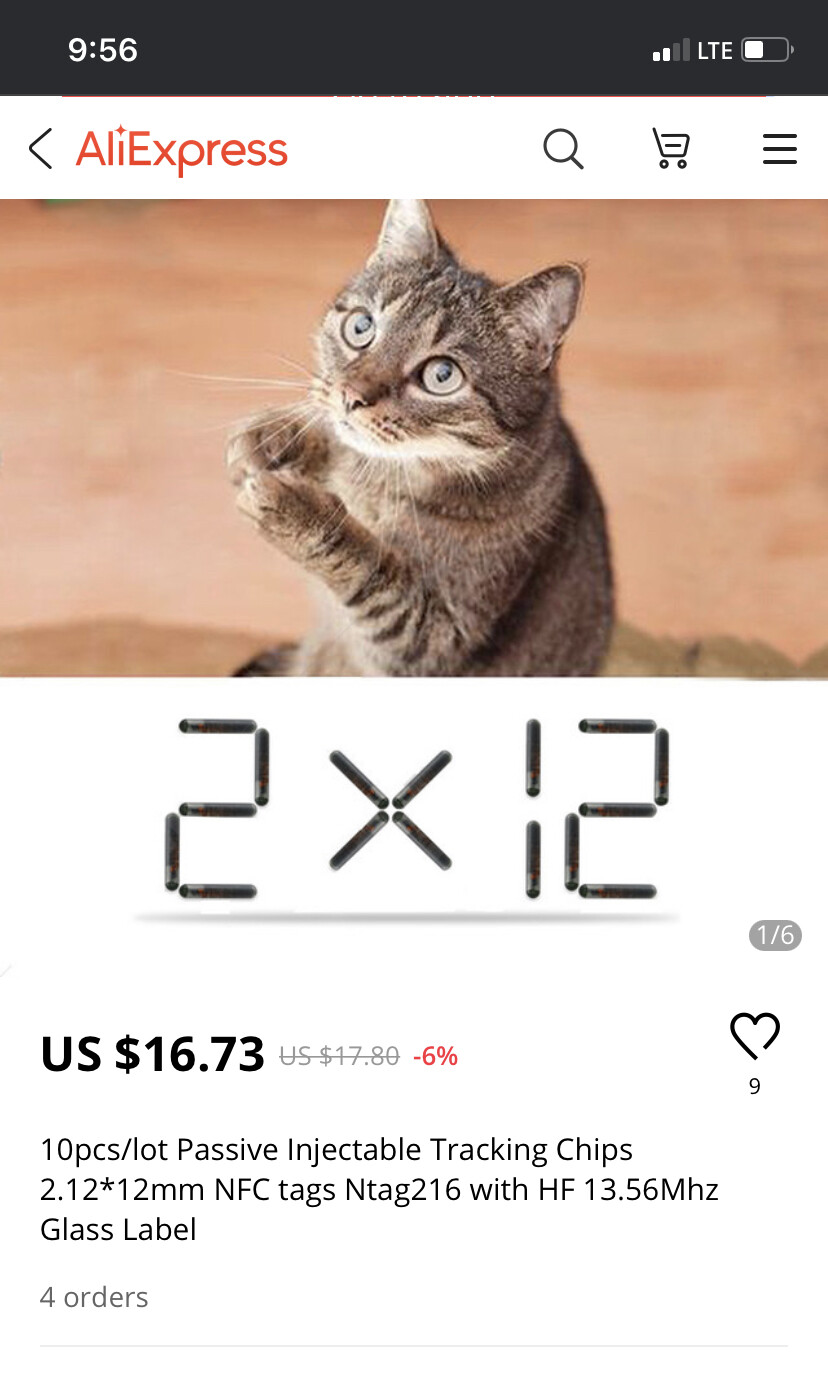
You can also write the chips to not show up with anything so they don’t pop
They absolutely don’t have a proxmark
They also aren’t metal detectable
You can also write the chips to not show up with anything so they don’t pop
They absolutely don’t have a proxmark
They also aren’t metal detectable
I respect that this has to be your call, but one other suggestion might be to ask them is “disabling it” is enough. Explain that removal means slicing your hand open with a scalpel and stitching it back shut, which you obviously don’t want to do and they likely don’t want to even think about, then say you can just disable it if that meets their requirements. Use a PM3 to set it to something that the access panels at work won’t beep, and call it good. If/when you get a new job you just “reactivate” it…
Did you mean “small glass chip, or a potato-chip?”
.
Geometrically known as a hyperbolic paraboloid…if anybody cares
we know, it’s ok, you’re allowed to be wrong 
What a mess. I’m truly sorry it has come to this, logic aside, this does set a bad precedent for future borgs.
I agree with the “just tell them you did“ they really have no legal right to touch you to check or scan you against your will… I also love the idea of bringing in a scalpel and having them do it or let them watch you do it because that would be horrifying for Normies.
Pretty much,
If you are going to make me cut my flesh open, I’m going to scar and damage you psychologically as much as possible
Bringing in (maybe real maybe fake) chips in a vial with a dollop of blood in it
This topic harshes my chill, and makes me rather nasty
I could just pull the chips off the cards and take those in lol.
There are so many various analogies that no employer would be able to get away, even though “at will” and it’s not a protected class
Protected class is meant to be extra clear that you can never (unless photography apparently) discriminate
Doesn’t mean everything else is fair game, just means it hasn’t been ruled clear discrimination yet
Imagine an employer telling you, you had to undergo laser tattoo removal, even though the Tattoos aren’t visable
Or telling someone they had to have breast implants removed
Or braces removed
No company could get away with that shit, even though it isn’t age/race/sex/disability/religious discrimination
@darkdragon885 we both know the legal entity you’ve been in contact is pretty focused on easy win cases, maybe you should look at someone less concerned about easy
Bingo
And if challenged why they no beep,
“I deleted my personal credentials, as I don’t trust you with them”
Can also buy china crap animal tags for super cheap, just for gods sake don’t inject them
I do kinda pick some up to embed in 3d prints maybe,But stickers are easier
Those are two different issues: the former says you can’t treat somone in a wheelchair any differently than a similarly qualitied person who has two working legs, unless the wheelchair conflicts with the job description (i.e. you’re allowed to hire a fully-abled person over a disabled person if they apply to be a lineman).
The latter is a bodily integrity issue, i.e. whether you’re allowed to interfere with someone’s bodily inviolability through social pressure or plain coercion. For lawyers, it’s a minefield: you might think forcing someone to remove an implant is a no-no that would never fly in court. But consider this: abortion and euthanasia are also bodily integrity issues, and no lawyer will touch those with a 304.8 cm pole.
You’ve not been paying attention to legal politics in the last decade? Lol
Lawsuits after lawsuits both ways
I also haven’t heard of any cases of someone forcing an abortion or non medical professional pushing for euthanasia besides family for quality of life
If an employer tried to force an employee to get an abortion I’m sure someone’s head would roll
I see a large difference between the state not letting you do something to yourself,
And a private entity coercing you into doing something to yourself

The issue seems to be with the chip, or maybe the country it was made, no?
Seriously it feels like an argument against a flat earther.
You know that makes me think,
Public shame is always an option,
@darkdragon885, you could reach out to a news source and see if they are interested in the story
Make sure you highlight their bullshit claims that China can track and spy on you
Difficult situ. I can not mention shit about the place I worked b4 or where I am employed now. In the contract… they can sue, if they want to.
Hi @darkdragon885! When you have an opportunity, no hurry, DM me please. I would like to discuss this situation and potentially incorporate it in my research on biohacking and identity construction/socio-economic-cultural-political implications.
Damn… this whole thread just makes me angry. Feel bad for you, @darkdragon885 , for I know it is just a fucked up situation when you have to chose between staying true to your ideals (and what is right, in this case) and keeping a job. It’s a shame people are forced to make such decisions at all.
On this one - there are some jobs where some piercings are impractical, because you could catch on them and hurt yourself (in this case, putting some tape over them would be sufficient), but other than that, there are no jobs that can be prevented by piercings, and tattoos even less. I work in retail, and I can sell stuff equally good as my non-pierced, non-tattooed, non-scarified and non-implantee colleagues
Thing is, employers especially in retail just worry far too much about “what would the customer think?”. Customers don’t really give a fuck at how you look, as long as you are friendly, competent and simply provide solutions for the questions they have. If I go to a shop of any kind, I don’t care if the selling person is male, female, trans or whatever, if (s)he is fat or anorexic, if (s)he wears a suit or some casual clothes, if (s)he has bodmods or not - I care if the person can answer my questions and sell me the thing I actually need. I might think “oh hey, I like that style!” or rather “nah, that just looks terrible”, but this is sooo irrelevant for my decision where I buy my stuff.
I agree with all the others here who don’t like letting the employer get away with that shit, especially since a chip is not the least bit visible, poses no security risk at all (so it’s totally non-sensical to force you having it removed) and require at least some sort of surgery to get it out.
Two very good ideas, I think - and, like others said, get it all written down, and maybe turn to some journalist or something the like (check your contract before to be sure what you’re allowed to talk about). If they insist that you take your chip out, make it as annoying for them as possible.
Another thing - how do you feel at work generally? How is the atmosphere, how do you get along with your colleagues, how is the payment and overall conditions? And how easy would it be for you to find another job?
All things to consider - because to be honest, I would plain on refuse to work for someone who forces me to have a surgery done to remove something that does in no way affect my job at all. But I understand that this might not be possible if you might end up without a job to pay your bills…
I don’t doubt that for one minute, and I have no doubt anybody can do a good job regardless of how they look if they’re qualified - be in retail, airlines or whatever. You know it, I know it, most everybody agrees with it.
But remember: you live in Germany. What is acceptable there is not acceptable everywhere. I can tell you without the shadow of a doubt that many US customers would walk out the door and/or complain to the store’s head office because they’re “shocked” or “put off” by your looks. Some people there are pretty intolerant, and it only takes some people to spook a company’s HR department. The last thing they want is bad publicity.
Sad, but that’s how it is.
As for the scalpel-the-chip-out-or-lose-your-job thing, it’s staggering that this is even possible. Not only from the perspective of labor laws - for someone like me who’s escaped the US style of wage slavery known as “employment at will” - but also from a human and technical point of view: it takes a particularly callous person to demand something like that of another human being, it takes a particularly ignorant person to even think this is a problem in the first place, and it takes a lot of hubris to declare it a problem without even researching what it is about before passing judgment.
But I know I’m preaching to the choir here.
I’m afraid you’re right… funny enough, in Mosambique, people were surprised about my looks, but more in a positive way - they asked some questions about it and all, but they were not “put off” or something like that. So I might get along better in some 3rd-world-countries than in the US…
But even here in Germany, there still is this misconception that I do all this bodmod-stuff to “provoke” or to stand out or whatever, just to annoy my fellow people. Did anyone ever tell a man with a beard that he just wants to provoke the well-shaved other guys? That a woman dying her hair brown just does so because she wants to stand out from the blondes? Soooo stupid…
Luckily, I don’t really know this concept, but I do know that labor laws in the US are just almost non-existant from a european point of view… why doesn’t that change? Is nobody over there fighting those practices? Really asking out of curiosity, like I said, I don’t know much about this…
Yeah, but still, it might at least feel nice for @darkdragon885 to hear some solid common sense on that topic - and maybe some good ideas as well 
Employment at will is quite simple: you leave whenever you want, the company offloads you whenever it wants. No explanation needed, no questions asked. The only requirement is that you give 15 days notice.
The idea in theory is, you and the company stay together as long as you’re happy together, and you part ways when it don’t work out no more, no strings attached. Pure capitalism in action.
The only problem is, that’s in fantasyland - which is what Americans are sold on the idea of. In the real world, you need a job, and the company has your replacement on the starting blocks because there are more applicants than jobs to go around. The net result is, you do as you’re told or you’re out.
In most European countries, this de-facto one-sided deal has been recognized, and restrictions have been put in place so bad employers can’t take unfair advantage of their workforce. It does have drawbacks - chief of which is making hiring more difficult, because companies have to be very careful who they hire lest they get stuck with the bad apple, thereby increasing unemployment somewhat. But those who do find a job and get hired full time can’t get ditched like an old tissue without due process.
Two words: Horatio Alger.
Since birth, Americans are spoon-fed the idea that, if they work hard, they can make it. If they find the right opportunity, they can strike it rich. And they cling to that idea like a bad fart in an elevator.
The reality of America, as in the rest of the world, is that without intervention from the state, rich people get richer, their offsprings have many more opportunities in life that poor people’s children, and the oligarchy perpertuates itself from generation to generation.
In what Americans believe are “socialist” countries (as if it was a dirty word), like France or Germany, a child born to a poor family has an (almost) equal chance to pursue a higher education and land a high-paying job as a rich child. It’s not that simple of course, but it’s as close as it gets. In America, unless the poor kids gets lucky, they’re almost guaranteed to stay in the same quagmire as their parents.
Statistically, that’s what happens. But Americans ignore the stats and cling to the Horatio Alger myth. Don’t ask me why, it’s not rational to me, but that’s how it is.
Me, I live in countries that care for the young, care for the old, care for those less fortunate who lose their health or lose their job, and I happily pay taxes for that. I don’t have kids, but the taxes I pay to educate other people’s is my legacy to the future, and the taxes I pay for other people’s social security is my gift to them. And most importantly, I’m happy to pay for those things because, if bad things ever happen to me, society will take care of me too.