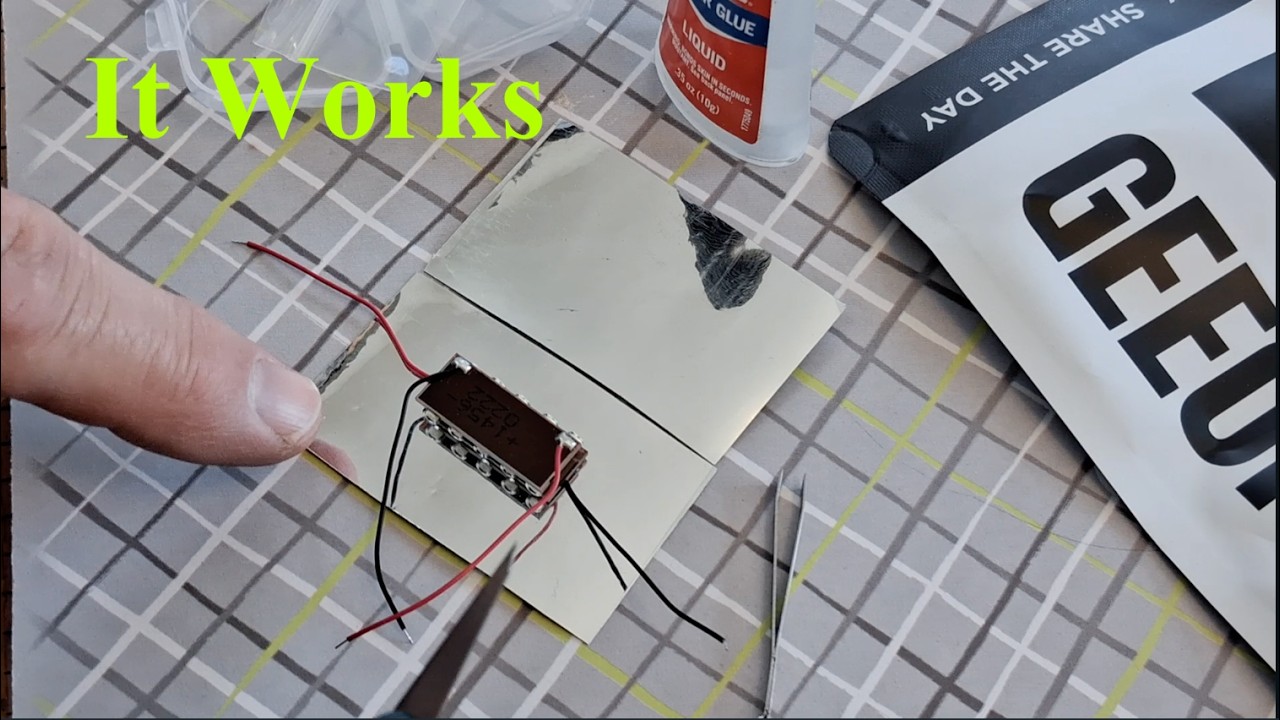
Long story short, the guy sandwiched 5 tritium vials between 2 calculator style solar panels, and enclosed it in reflective material. It’s a tiny tiny trickle of power, but assumably huge compared to rfid power harvesting.
Implant tritium bad. (but in a polished SS liner encased in bio goop?)
Tritium half-life is just over 12 years, but plan for half power and maybe be usuable for 24 years as a power source?
So… What could you do with 1 volt @ milliamps (at best)?
Actually inductive energy harvesting, even for NFC devices, is orders of magnitude higher power than what is effectively a beta voltaic cell.
The advantage of course is that the flow of current is basically constant. However, the energy density of the cell and the storage medium you would undoubtedly need in order to collect enough current to use a voltage buck converter to power your application is extremely low. You might almost be better off putting two of these cells in series to get around two volts vs trying to convert 1 volt to something usable.
Well, just going off the video, I think he got 2 volts. I just halved it for half life. That said he was using 2 solar panels (tiny) in a sandwhich, connected in series.
Maybe 4 panels in a rectangular tube kinda thing, then put 8 tritium vials inside with the axis long ways, so you have a group of 4 sitting end to end with a group of 4.
Teeny tiny power. But would it run a subdermal led watch like @Satur9 once proposed?
Not even close. Volt meters are specifically designed to have a high input impedance to avoid disrupting the circuit being measured, the fact that he can’t take a measurement without drawing the voltage down shows that it’s generating a ridiculously small amount of power.
The datasheet for the solar panel says that under perfect conditions (directly under a bright light with a load specifically tuned to extract the maximum power), it will generate up to 7.95uW. A single ultra efficient red LED (1.8V @ 2mA) needs about 3,600uW. A normal green LED (2.5V @ 20mA) needs 50,000uW.
Designing for it to work until the end of 24 years would mean you can only draw 1/4 of its max power. It would be putting out 1/2 at the end of 12years, and that’s without factoring in inefficiencies in the solar panels as the brightness drops off.
It’s a neat trick, and probably useful in a handful of very specific circumstances, but if you built one large enough to replace a single coin cell battery it would be the size of a fridge and cost hundreds of thousands of dollars.
After watching the entire video, I find it interesting that even given the design of the volt meter, the current output is so little that it is still drawing down the voltage when measuring directly. This is evident in the fact that when connected to a capacitor, the voltage is allowed to climb to approximately 2.7v.. but it immediately starts dropping once the meter is applied.
Because of this, I don’t think the MP28600GTF would actually be necessary.. and in fact I have doubts it would work at all without an efficient storage capacitor anyway.
I notice that he actually had room for 10 vials, but used 5 and spaced them out. Doubling the vials should improve output, I don’t think that the light from neighboring vials would be re-absorbed / wasted???
You can get rectangular tube tritium vials, if you found a size of vial and solar cells that would stack into a neat 4 sided package… Then my broad assumptions are, twice as much light (no vial spacing), and twice as many cells, so 4 times as much power? Then you would have double voltage from the extra light, and double amperage from wiring the extra cells in parallel.
This seems like a very expensive AA battery sized unit, which is still very unlikely to be useable. Still, things to make you go, hmmm? Right?
i’m pretty sure the other 5 were attached in an offset pattern to the other solar panel, and when sandwiched together there were 10 total.. though something in my brain says he used 12 somehow? did he mention 12?
Dude’s a redneck in Murica, you’re lucky he even attempted the “A”.
edit.
Oh, man. He tried 2 videos back to make a betavoltaic cell using the radioactive source from a smoke detector, and he really struggled to say “Americium”, then went to the same pronunciation source you just used!
I’m betting he went with 5 because that was the package qty on offer via aliexpress Anyway.. it’s interesting I guess. Could probably bump the # of tubes and maybe explore a higher efficiency photovoltaic cell chemistry for those wavelengths of light. I doubt any actual beta particles or higher energy interactions are producing electron movement in the cells.
Well I hope he had fun and didn’t break any vials muckin about XD
Commercially available betavoltaics use the raw isotope with photovoltaic panels tuned to absorb the beta radiation (electrons) directly. Using the phosphor to convert the beta decay to visible light and then using traditional solar panels is a comically inefficient way to generate power from an already abysmally low power system.
I don’t know if you saw my Endochron posts, but Widetronix offered to make us a 2uW (526nA @ 3.8V) 8 x 8 x 2mm SMT package.
If I were to continue to pursue this technology, I would look for a Nickel-63 betavoltaics, because it has 100x the power output and a 100 year half life. Even so it’s still a tiny sliver of power. You would need to use hybrid supercapacitors which are also difficult to spec and source to store any measurable amount of energy, because EDLC capacitors have too high self discharge. I’m looking into other solutions still, but the NRC kind of prevents me from exploring betavoltaics commercially right now.
I ordered and will be testing some of these lithium titanate batteries and I’ll let you know how that goes.


 Anyway.. it’s interesting I guess. Could probably bump the # of tubes and maybe explore a higher efficiency photovoltaic cell chemistry for those wavelengths of light. I doubt any actual beta particles or higher energy interactions are producing electron movement in the cells.